Monday, 15 November 2010

Be Careful of Holiday Toxins and Dangers

This is the time of year when pets can be exposed inadvertently to toxic substances or tempting taste treats that can be dangerous.

One "toxic" plant you don't have to worry much about is the poinsettia, though. These plants are either nontoxic or only slightly irritating to the gastrointestinal tract, depending on the reference source. On the other hand, mistletoe berries are poisonous and it is best to be very careful when hanging mistletoe so that pets are not exposed to the berries. Even one or two berries of this plant may be fatal. Even the products used to help plants make it through the holidays can be a problem.

Some of the solutions used to make the Christmas tree last through a long holiday season can be pretty irritating to mouth or stomach tissues. If you add these to the water in your Christmas tree stand you should be sure that pets can not drink the water.

Plants are not the only problems. Holiday food treats and decorations can be dangerous to pets. It takes a fairly large amount of milk chocolate to cause poisoning problems in dogs and cats but a whole box of chocolates is likely to cause diarrhea at the least and may be toxic to smaller pets.

Tinsel strands seem to be very attractive to cats and these will often cause severe problems, often requiring surgical removal to prevent the death of the cat if they are ingested. For some reason, almost every season a dog or cat in our practice eats a Christmas tree ornament or even one of the light bulbs off the tree. Chewing on the extension cords to the tree lights or the electric train around the tree sometimes leads to problems, too.

The abundance of food found at holiday tables presents a danger even if it isn't cooked by your mother-in-law who believes in partially thawing the turkey then cooking it a 200 degrees. We see a definite increase in pancreatitis around the holidays due to pets getting fat laden table scraps. At least one dog a year manages to eat the whole turkey carcass and has a major case of constipation in a day or so. Try to resist the urge to cover the pet's food with the extra gravy and put the trash out of reach of pets after an attractive meal!

Pets sometimes have a really hard time adjusting to the increases in family activity around the holidays. They may not handle the stress of house guests well. Often just scheduling a few minutes at approximately the same time each day to spend playing with your dog or reviewing those obedience exercises can make the holidays a lot easier for an anxious canine. Cats are a little harder to reassure and it is sometimes best just to make sure they have a safe haven in the house where the guests can't find them, especially the very young guests. Make sure their litter pan is private, too.

If you are going to board your pet for the holidays make sure their vaccinations are current well before the time for boarding and check to see if there are special vaccination requirements at the boarding kennel, such as requiring Bordetella (kennel cough) vaccination. Make sure you have all the contact numbers for wherever you will be written down for the kennel, pet sitter or veterinary hospital. You might even consider giving your vet written permission to treat your pets in your absence, especially if your relationship with your vet is not close enough to be sure he or she would be comfortable caring for the pets without your permission.

Do not tranquilize pets for air travel if you are taking them with you, unless you are absolutely certain it is necessary. A recent review of pet deaths during airplane trips revealed that most of the pets who died had been sedated. The effects of sedatives are intensified at higher altitudes and even though cargo holds are pressurized they are at a lower atmospheric pressure than is found at ground level. If you do have to sedate a pet follow the veterinarian's directions EXACTLY. It could save your pet's life!

If you take a little time to prepare and think about the special risks holidays impose your pet should be safe. Just in case, make sure you know the number of the emergency veterinary hospitals in your are and can drive by it to be sure you can find it an emergency when you may not be thinking as clearly as on an ordinary day.

Tuesday, 26 October 2010

Halloween Pet Safety Tips


From the ASPCA, we have a set of essential safety tips for ‘pet parents’ to keep furry family members safe and sound during the upcoming Halloween period:
  • All but the most social dogs and cats should be kept in a separate room during peak trick-or-treat visiting hours. Too many strangers in unusual garb can be scary and stressful for pets.

  • When opening the door for trick-or-treaters, take care that Max or Mittens doesn’t dart outside. Make sure all your pets are wearing current identification, just in case.

  • No tricks or treats: Keep all Halloween candy out of your pet’s reach. Chocolate can be poisonous to animals, and tinfoil and cellophane candy wrappers can be hazardous if swallowed.

  • It’s not a bright idea to keep lit pumpkins around companion animals. Pets can knock them over, and curious kittens especially run the risk of being burned.

  • Don’t leave your pet in the yard on Halloween. There have been reports of vicious pranksters who have teased, injured, stolen and even killed pets on this night.

  • Although the ASPCA recommends that cats remain indoors at all times, it is especially important to keep your feline inside for several days before and after Halloween. Black cats in particular may be at risk from children’s pranks or other cruelty-related incidents. As a safety precaution, many shelters will not adopt out black cats around Halloween.

  • Don’t dress up your dog or cat unless you know he or she loves it. If you decide to do so, make sure the costume isn’t annoying or unsafe, and doesn’t restrict her movement, vision, hearing or ability to breathe or bark. Avoid costumes with small or dangling accessories that she could chew off and possibly choke on. Make sure an adult supervises pets in costume at all times.

Monday, 30 August 2010

Current Prices

Full Trim

Includes: nails trimmed, ears cleaned and plucked, anal glands, hand scissoring when appropriate, bows and/or bandanna.

  • TOYS (10 " or less) $32 - $46
  • MINIATURES (10" to 17") $34 - $51
  • MID SIZE (17" to 22") $36 - $61
  • LARGE (45lbs and up) $51 and up


Basics:

Includes: nails trimmed, ears cleaned and plucked, anal glands, light clipping on face and feet when appropriate, bows and/or bandanna.
  • TOYS (10" or less) $26 and up
  • MINIATURES (10" to 17") $29 and up
  • MID SIZE (17" to 22") $31 and up
  • LARGE (45lb and over) $36 and up


Bath/Brush

Includes: nails, ears, and anal glands only.
  • TOYS (10" or less) $22 and up
  • MINIATURES (10" to 17") $24 and up
  • MID SIZE (17" to 22") $26 and up
  • LARGE (45lb and over) $31 and up


Other Services:


Cats:
(all trims for cats require sedation)

  • BATH/BRUSH
    $28 - $38
  • SHAVES AND TRIMS
    $38 and up

Sunday, 29 August 2010

Dog For Sale


  • Free to good home.
  • Excellent guard dog.
  • Owner cannot afford to feed him anymore, as there are no more thieves, murderers or molesters left in the neighborhood for him to eat.
  • Most of them knew him as 'Holy Shit.'

Found at: More Cool Pictures

Saturday, 28 August 2010

Puppyland!

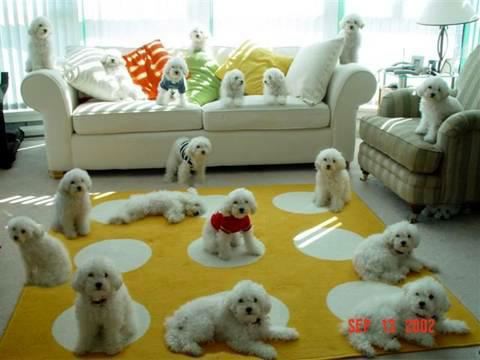
Puppyland!

I can't decide if this is cute or scary!
What do you think!

Found at: Way Cool Pictures

Saturday, 14 August 2010

Spotlight on Bichons


A cheerful, happy dog, the Bichon Frise is small and sturdy with a dark-eyed inquisitive expression and a plumed tail it carries merrily over the back. The breed is often compared to a cotton ball due to its curled double coat, which consists of a textured outer coat and a silky undercoat. The coat must be white, but may have shadings of buff, cream or apricot around the ears or on the body.

General Appearance
The Bichon Frise is a small, sturdy, white powder puff of a dog whose merry temperament is evidenced by his plumed tail carried jauntily over the back and his dark-eyed inquisitive expression.

A Look Back
The Bichon Frise appeared in the 13th century as a descendent from the Water Spaniel. Because of their merry disposition, they traveled much and were often used as items of barter by sailors as they moved from continent to continent. The dogs found early success in Spain and it is generally felt that Spanish seamen introduced the breed to the Canary Island of Teneriffe. In the 1300s Italian sailors rediscovered the little dogs on their voyages and are credited with returning them to the Continent, where they became great favorites of Italian nobility. Often, as was the style of the day with dogs in the courts, they were cut "lion style."

The "Teneriffe" or "Bichon" had success in France during the Renaissance under Francis I (1515-47) but its popularity skyrocketed in the court of Henry III (1574-89). The breed also enjoyed considerable success in Spain as a favorite of the Infantas, and painters of the Spanish school often included them in their works. For example, the famous artist, Goya, included a Bichon in several of his works.

Interest in the breed was renewed during the rule of Napoleon III, but then waned until the late 1800s when it became the "common dog", running the streets, accompanying the organ grinders of Barbary, leading the blind and doing tricks in circuses and fairs. Although the breed’s colorful past includes use as a circus dog, today the Bichon is enjoyed primarily as a companion animal.

On March 5, 1933 the official standard of the breed was adopted by the Societe Centrale Canine of France. As the breed was known by two names at that time, "Teneriffe" and "Bichon", the president of the International Canine Federation proposed a name based on the characteristics that the dogs presented - the Bichon Frise. ("Frise" refers to the dog's soft, curly hair.) On October 18, 1934 the Bichon Frise was admitted to the stud book of the French Kennel Club.

Right Breed for You?
The Bichon is a naturally gentle, playful dog. He loves activity and requires regular exercise. His hair grows continually and does not shed, so extensive grooming is a must to prevent mats. Bichons also tend to be a good breed for allergy sufferers.

Temperament
Gentle mannered, sensitive, playful and affectionate. A cheerful attitude is the hallmark of the breed and one should settle for nothing less.

If you are considering purchasing a Bichon Frise puppy, learn more here.

© The American Kennel Club, Inc.