Tuesday, 30 March 2010

A Quick Lesson On Dog Hair


Every hair in the dog coat grows from a hair follicle, which has a cycle of growing, then dying and being replaced by another follicle. When the follicle dies, the hair is shed (moults). The length of time of the growing and shedding cycle varies by breed, age, and by whether the dog is an inside or outside dog.

Many dogs shed their undercoat each spring and regrow it again as colder weather comes in; this is also referred to as blowing the coat. Many domesticated breeds shed their coat twice a year. In some climates, the topcoat and undercoat might shed continuously in greater and smaller quantities all year.

Coat textures vary tremendously. Densely furred breeds such as most sled dogs and Spitz types can have up to 600 hairs per inch, while fine-haired breeds such as the Yorkshire Terrier can have as few as 100, and the "hairless" breeds such as the Mexican Hairless and the Peruvian Inca Orchid have none on parts of their bodies.

Texture, like colour and pattern, might be called by different terms for different breeds, even when referring to the same quality of coat. Some terms used to describe dog coat texture are smooth, rough, curly, straight, broken, and silky.

The texture of the coat often depends on the distribution and the length of the two parts of a dog's coat, its thick, warm undercoat (or down) and its rougher, somewhat weather-resistant outer coat (topcoat, also referred to as guard hairs). Breeds with soft coats often have more or longer undercoat hairs than guard hairs; rough-textured coats often have more or longer guard hairs.

What follows is a short description of the various coats and what they mean:

Double Coated:
Means having both a soft undercoat and a coarser topcoat. Some breeds with this type are Poms, Huskys, Samoyeds, Collies, Shelties and Akitas. The undercoat of a double coated breed can become very matted very easily. These are the heaviest shedders.

Undercoat:
The undercoat lies closest to the dog's skin and grows in clusters from a single follicle. The undercoat has a soft, downy appearance and works to protect the skin from cold weather.

Outercoat:
This is composed of long, stiff guard hairs that protect the undercoat.

Single-coated:
Lacking an undercoat. Single coated dogs include poodle, Maltese, Yorkshire Terrier,
Soft Coated Wheaton Terrier, Kerry Blue Terriers, Portuguese Water Dog. Many of these dogs do not shed much if at all.

Smooth-coated:
Smooth to the eye and touch. This would refer to dogs such as beagles, labrador retrievers, greyhounds, etc. Smooth coated dogs often shed quite a lot.

Long-haired:
A "long haired" dog typically has hair longer than an inch or so.

Short-haired:
Dogs referred to as short-haired have hair around an inch long or shorter.

Wire-haired:
Also called broken-coated. The harsh outer guard hairs are prominent, providing excellent weather protection for hunting dogs such as the Border Terrier or Wirehaired Pointing Griffon. Shedding is minimal for most wire-haired dogs.

Tuesday, 23 March 2010

All About the Irish Terrier

The Irish Terrier sports a beautiful red coat, an alert expression and trim outline with piercing eyes that reflect a rare intelligence. He is a gallant picture of authentic terrier type and character. The breed is good tempered, spirited and game. The breed’s coat is short and wiry in texture.

A Look Back:

His origin has been much debated, but there is indisputable evidence that he is one of the oldest of the terrier breeds. Early Irish Terriers came in a variety of colors, including black and tan, gray, and brindle. It was only near the end of the 19th century that the solid red color become a fixture of the breed. In World War I the Irish Terrier was used as a messenger and sentinel.

Temperament:
The temperament of the Irish Terrier reflects his early background: he was family pet, guard dog, and hunter. He is good tempered, spirited and game. It is of the utmost importance that the Irish Terrier show fire and animation. There is a heedless, reckless pluck about the Irish Terrier which is characteristic, and which, coupled with the headlong dash, blind to all consequences, with which he rushes at his adversary, has earned for the breed the proud epithet of "Daredevil."

He is of good temper, most affectionate, and absolutely loyal to mankind. Tender and forebearing with those he loves, this rugged, stout-hearted terrier will guard his master, his mistress and children with utter contempt for danger or hurt. His life is one continuous and eager offering of loyal and faithful companionship and devotion. He is ever on guard, and stands between his home and all that threatens.

Right Breed for You?

The Irish Terrier is a smart, quick dog that quickly adapts to new situations. He’ll guard his home and family members with determination and pluck. This breed is great with children when raised with them and is deeply loyal to his owner. Pups require firm boundaries so they will grow into respectful adults.

Tuesday, 16 March 2010

Happy St Paddy's Day!


May your blessings outnumber
The shamrocks that grow,
And may trouble avoid you
Wherever you go.

~an old Irish Blessing


Sunday, 21 February 2010

Cabin Fever


Not all dogs get out and enjoy wintery weather like this guy! So, we thought it might be good to post the following article about cabin fever:

Going inside - and staying there - provides physical protection from the elements, but also opens the door to a mental hazard: boredom. A bored dog can wreak considerable havoc on his household in the form of excessive barking, hyperactivity, and destructiveness. Worse still, if the dog's efforts to relieve his boredom prompt him to partake of poisonous plants or other toxic substances, he'll need immediate veterinary attention, and you are likely to face a significant bill.

To prevent such occurrences, be sure to dog-proof your home; in other words, put any toxic, hazardous, or other forbidden items beyond your dog's reach. Then, find ways to provide your dog with plenty of indoor physical and mental exercise. Here are some activities that you and your dog can do together indoors to help the two of you stay sane:

Fetch:
A rousing game of fetch - particularly if it requires your dog to go up and down some stairs a few times - can give him a good physical work out.

Tug-of-war:
As long as you are not having aggression problems with your dog, a good tug session can siphon off considerable excess cannine energy. Rules of the game: The person needs to start the game, the person needs to end the game, and most of the time the person needs to win the gam.

Hide the toy:
To give your dog a mental workout, try hiding a toy or treat and then directing him to find it. Hold the item for him to see, then place him in another room so he can't see where you hide the object. Once you've hidden the toy, allow him to come out and look for it. When teaching this game, put the toy or treat in plain sight, gradually increase the difficulty until your dog understands how to look for it.


source: The Family Dog

About Scotties

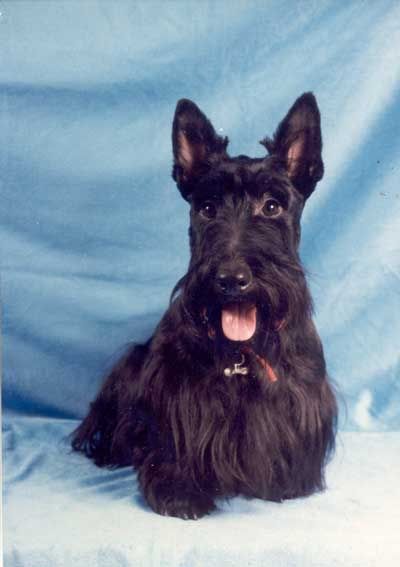
The Scottish Terrier, often called the "Scottie," is best recognized for its distinctive profile and hard, wiry, weather-resistant outer coat in a black, brindle or wheaten color. Its beard, eyebrows, legs and lower body furnishings are traditionally shaggy. Like many breeds in the Terrier Group, Scotties are small yet strong and known as fast, alert and playful dogs. The Scottish Terrier is the only breed of dog that has lived in the White House three times, with Presidents Roosevelt and George W. Bush.

A Look Back
Naturally a "digger" at heart, the Scottie was originally bred to hunt and kill vermin on farms. King James VI, known to adore the breed, is said to be responsible for the rise in popularity in Scotland during his reign. Scotties were introduced to America in the 1890’s and continue to remain a common fixture in American households.

Right Breed for You?
Scotties thrive as house pets and are gentle, loving members of their families. Their spirited natures require obedience training, and they need regular exercise (on leash, as the chase instinct is strong). The Scottie coat requires regular brushing and clipping to maintain the characteristic breed outline.

Love Story


Isn't this sweet?
I do not know the story behind these pictures, but the love is evident.

Found at: Way Cool Pictures

Wednesday, 10 February 2010

25 Ways To Be Healthier

1: Brush twice a day!

2: Dress right for the weather.

3: Visit the dentist regularly.

4: Get plenty of rest.

5: Make sure your hair is dry before going outside..

6: Eat right.

7: Get outside in the sun every once in a while.

8: Always wear a seatbelt.

9: Control your drinking of alcoholic beverages.

10: Smile! It will make you feel better.

11: Don't over indulge yourself.

12: Bathe regularly.

13: Read to exercise the brain.

14: Surround yourself with friends.

15: Stay away from too much caffeine.

16: Use the bathroom regularly.

17: Get plenty of exercise.

18: Have your eyes checked regularly.

19: Eat plenty of vegetables.

20: Believe that people will like you for who you are.

21: Forgive and forget.

22: Take plenty of vacations.

23: Celebrate all special occasions.

24: Pick up a hobby.

25: Love your neighbor as yourself.

Now send this to your computer buds to give them a warm fuzzy!