Showing posts with label Parasites on Dogs. Show all posts

Tuesday, 27 April 2010

Keeping Ticks Off Your Pet


The best way to keep ticks off your pet is to regularly inspect your pet whenever he or she comes in from outdoors, and remove any ticks you might find. You might also want to take a look at our post on keeping ticks out of your yard. In addition, there are a number of products on the market that can be used to discourage and repel these pesky critters, and here's the scoop on that:

If your pet goes outside regularly, you can use some type of residual insecticide. Frontline (fipronil) is a liquid applied to the skin between a dog’s shoulders that discourages ticks from staying or implanting. Revolution (selamectin) is labeled for one kind of tick. A permethrin spray can be used on dogs (but not in cats, for whom it can be fatal) as a tick repellent and killer.

If you use a liquid spray treatment, cats and skittish dogs typically prefer a pump bottle because of the noise from aerosol cans. Avoid topical powders if your pet has a respiratory condition. Powders are fairly easy to apply, but they can make a real mess, and they often contain permethrin. Shampoos are useful only for ticks that are already on your pet.

An amitraz collar, such as PreventicĂ’, has some efectiveness against ticks. Like Frontline, amitraz cannot keep all ticks off your pet, but it discourages ticks from implanting or staying on. The collar might be somewhat more water resistant than a residual insecticide, so if your dog likes to swim, the collar might be a better choice.

Flea combs can be used to help remove ticks. Wash your pet’s bed frequently.

Some people use a topical spray, but don’t realize they should not use more than one insecticide or repellent. Doubling the amount of anti-tick product, or using two at once, may cause toxicity problems. DEET, found in many over-the-counter insecticides, is toxic to pets. Any spray insecticide labeled for use on clothing should not be sprayed directly on pets.

Finding And Removing Ticks

The best way to find ticks on your pet is to run your hands over the whole body. Check for ticks every time your pet comes back from an area you know is inhabited by ticks. Ticks attach most frequently around the pet's head, ears, neck, and feet, but are by no means restricted to those areas.


If you find an embedded tick, do not simply grab its body and pull, as the tick's barbed hypostome (feeding tube) may break off and remain in the bite. Applying chemicals or flame to the tick is not a good idea because, while it may make the tick let go, it can also cause the tick to spit blood back into the wound, possibly sending disease germs into the bloodstream in the process.

The best way to remove a tick is to use rubbing alcohol and a pair of hemostats or sharp tweezers. Dab rubbing alcohol on the tick, and then use the hemostats or tweezers to take hold of the tick as close to the dog’s skin as you can; pull slowly and steadily. Try to grab it where its mouth-parts enter the skin and pull gently without letting go. It will eventually releases its hold by withdrawing its barbed mouth-part from the skin.

Try not to leave the tick’s head embedded in the dog’s skin. Do not apply hot matches, petroleum jelly, turpentine, nail polish, or just rubbing alcohol alone (the tick must be pulled out after application of alcohol) because these methods do not remove the ticks and they are not safe for your pet.

Once you have removed a tick, do not try to crush it - unengorged ticks are flat and very hard to crush, while engorged ticks will burst and release blood. Instead, you should flush the tick down a drain or seal it in a jar. (It can be useful to keep the tick to show to a doctor in case you or your pet gets sick from the bite.) Some people kill and preserve ticks by dropping them into bottles of rubbing alcohol; if you do this, do not use the alcohol in that bottle for anything else.

After you pull a tick off, there will be a local area of inflammation that could look red, crusty, or scabby. The tick’s attachment causes irritation. The site can get infected; if the pet is scratching at it, it is more apt to get infected. A mild antibiotic, such as over-the-counter triple antibiotic ointment can help, but usually is not necessary. The inflammation should go down within a week. If it stays crusty and inflamed longer than a week, it might have become infected.

Although ticks can transmit diseases, they are usually nothing more than a nuisance. The best approach is to prevent them from embedding, and once embedded, to remove them quickly. As long as you stay on top of the situation, your pets should cruise right through the tick season with no problems.

sources: Veterinary Partner and Regional Pest Management

Keeping Ticks Out of Your Yard


Deer ticks are most abundant in the woods where hosts for the tick flourish and ticks find high humidity levels necessary for survival. On lawns, most deer ticks (82%) have been recovered within 9 feet of the lawn edge, especially areas adjacent to woods, stonewalls, or ornamental plantings. Fewer ticks are found in the sunny, manicured areas of the lawn. Ticks may also be found in groundcovers such as Pachysandra.

Create a tick safe zone by altering the landscape to increase sunlight, reduce tick habitat and discourage rodent hosts. Create a clearly defined, manicured border. A dry wood chip, tree bark, mulch, or gravel barrier between woods and lawn can reduce tick migration into the lawn. The removal of leaf litter at the lawn perimeter also can help reduce the number of I. scapularis nymphs on the lawn. Landscape modifications include:
  • Keep grass mowed.
  • Prune trees, mow the lawn, and clear leaf litter and brush, especially along edges of the lawn, stonewalls, and driveways.
  • Move play sets away from the woodland edge.
  • Restrict groundcover in areas frequented by family.
  • Adopt some landscaping practices such as gravel pathways, mulches, decking, stone, tile, and other hardscapes around the home.
  • Wildflower meadows, herbal gardens, etc. have very few ticks and may be an acceptable alternative to grass in some areas.

Treating the yard and outdoor kennel area, if any, is an important tool in the arsenal against ticks. There are products containing fenvalerate, that can be used to spray the outdoor area. According to the CDC, Fenvalerate is not harmful to the environment, it is however, toxic to animals, pets, and people, so please use common sense.

The Life Cycle of a Tick


Most types of ticks require three hosts during a two or three year lifespan. Each tick stage requires a blood meal before it can reach the next stage. Hard ticks have four life stages: egg, larva, nymph, and adult. Larvae and nymphs must feed before they detach and molt. Adult female ticks can engorge, increasing their weight by more than 100 fold. After detaching, an adult female tick can lay approximately 3,000 eggs.

Adult females drop off the host to lay eggs after feeding, usually in the fall. During the egg-laying stage, ticks lay eggs in secluded areas with dense vegetation. The eggs hatch within two weeks. Some species of ticks lay 100 eggs at a time, others lay 3,000 to 6,000 per batch.

Eggs hatch into six-legged larvae and overwinter in this larval stage. When spring comes, the larvae move into grass and search for their first blood meal. They attach themselves to their first host, usually a bird or rodent. Later in the summer, engorged larvae fall onto the ground and molt into nymphs, usually in the fall.

Nymphs (which are generally the size of a freckle) remain inactive during winter and start moving again in spring. During the following spring, the nymphs seek out and attach to the second host, usually a rodent, pet, or human.

The nymphs feed on the second host and after this blood meal, fall off the host and molt into adults - off the host - in the late summer or fall. Throughout the autumn, the male and female adults try to find a host, which is again usually a rodent, pet, or human. If adults cannot find a host animal in the fall, they can survive in leaf litter until the spring.

The next spring, adults seek out and attach to a third host, which is usually a larger herbivore, carnivore, or human. The adults feed and mate on the third host during the summer.

The adult female feeds for 8 to 12 days. The female mates while still attached to her host, then both ticks fall off, and the males die. The female remains inactive through the winter and in the spring lays her eggs in a secluded place.

Females may reattach and feed multiple times. The three hosts do not necessarily have to be different species, or even different individuals. Also, humans may serve as first, second or third hosts.

source: Parasites and Health at the Center for Disease Control

What Is A Tick?


Ticks are small parasitic arachnids that live by sucking the blood of mammals, birds, and other animals. Not only a major nuisance to humans and domestic animals, ticks are also responsible for transmitting many diseases, including Lyme disease, Rocky Mountain spotted fever, and ehrlichiosis. Although there are hundreds of tick species, the major species of concern in the United States are the deer tick, the American dog tick, the brown dog tick, the Rocky Mountain wood tick, and the lone star tick.

The deer tick (Ixodes scapularis), also known as the blacklegged tick, lives in the eastern and middle U.S. and also has a close relative on the West Coast. It attacks many animals including humans, deer, and pets. Known for infecting humans with Lyme disease, the deer tick can also transmit human granulocytic ehrlichiosis and babesiosis.

The American dog tick (Dermacentor variabilis) is found east of the Rockies as well as on the West Coast. It prefers dogs but will also bite humans and other large mammals. It can transmit Rocky Mountain spotted fever to humans. The brown dog tick (Rhipicephalus sanguineus) lives throughout the U.S., and though it rarely bites humans, it is a highly annoying pest to dogs and other pets. It is not known to transmit disease to humans.

The Rocky Mountain wood tick (Dermacentor andersoni) occurs in the Rocky Mountain region of the U.S. and southwestern Canada. It transmits Rocky Mountain spotted fever to humans and blood parasites to cattle and dogs. It also can inject dangerous toxins into the host as it feeds.

The lone star tick (Amblyomma americanum) is found in the southeastern and mid-Atlantic United States. It has a painful, itchy bite and can transmit ehrlichiosis, tick-borne typhus, and tularemia to humans.

Appearance and habits:

A tick has eight legs, a tiny head, and a flat, seed-shaped body that swells up like a balloon as it feeds. Ticks that are only a few millimeters long before they bite can grow up to half an inch when engorged with blood. Their appearance varies depending on species, sex, and life cycle stage, but they are generally dark-colored, sometimes with distinctive patterns.

In each stage of a tick's life cycle (larva, nymph, and adult) it searches for a host, using its ability to sense heat, light, and carbon dioxide. The tick often crawls to the top of weeds, grass, and other vegetation so that it can grab a passing host animal with its front legs. Once it has grabbed onto a host, it may bite any part of the body but usually prefers to crawl to the top of the host and bite the head, neck, or ears. The tick uses fanglike mouth parts called chelicerae to pierce the skin, and inserts a feeding tube called a hypostome. The hypostome is barbed, making it very hard to remove the tick by pulling. The tick drinks blood until it is full, then drops off the host to molt or lay eggs.

People typically acquire ticks in the spring and summer, while walking through tall grass, woods, and weedy areas. Many ticks can smell animals and are thus attracted to paths and trails where their potential hosts travel. They can also infest homes if carried indoors by pets.

Tuesday, 4 August 2009

Our Flea Shampoo

The flea shampoo we use here at Heavenly Pets is the D-LIMONAIDE Citrus Conditioning Shampoo from Harco Natural Groomer.

D-Limonaide Shampoo is made from D-LIMONENE, an extract from orange peels, blended with natural herbal oils, cedarwood, worm wood, and freskomenthe. The shampoo conditions with a special blend of Aloe Vera gel and plant derived proteins.

This combination makes a superb deep cleaning and conditioning shampoo, and an excellent alternative to pesticide shampoos. D-Limonaide Shampoo is useful for treatment of fleabite dermatitis, is gentle for puppies and kittens, and leaves a pleasant scent which deodorizes the strongest odors.

ACTIVE
INGREDIENTS:
7.5% d-Limonene, Worm Wood Oil, Freskomenthe Oil, Jojoba Oil, Avocado Oil, Cedar Wood Oil, Calendula Oil, Camille Oil.

Monday, 3 August 2009

The Flea Spray We Use

If your pet has a flea problem and is not currently on any kind of flea preventative, the product we use as part of our flea treatment program is Ovitrol Flea Spray. It effectively kills the live fleas on your pet, and also repels ticks, mosquitoes, lice and flies.
Ovitrol contains Precor Insect Growth Regulator, which will (according to their product information) kill flea eggs and larvae for up to 2 months when used as a spray for floors and furniture.

The spray can be reapplied weekly, and is safe for use on dogs, puppies, cats, kittens, horses and ponies. Do not use on puppies or kittens under 12 weeks of age. Contains Pyrethrins and S-Methoprene.

Thursday, 2 July 2009

Moving In With Fleas

Q: I just moved into a new apartment. It is infested with fleas. Where did they come from and what can I do?

A: The people living there before you probably had a pet. Even if the apartment was treated with insecticides before you moved in, the treatment may not have penetrated the carpet to kill developing fleas.

For more information you can read the following posts on fleas:

Why Do I Still Have Fleas?

Q: I have bombed my house for fleas three times this month and still have them. Why?

A: It is likely that you are seeing adults emerge from cocoons that were produced before you bombed. The cocoons are deep within the carpet and treatment may not have reached them. If you did not treat your yard new fleas may be coming indoors on you or your pets. If the foggers you used contained pyrethrins or pyrethroids, you probably only killed larvae and adults. Insect growth regulators are available in foggers and will prevent development of immature fleas.

For more information you can read the following posts:

Treating Your Yard For Fleas

Flea larvae develop in shaded, humid areas, but will drown in a flooded environment. Rainfall is often enough to curb larval development outdoors. In addition to drowning, the fecal dried blood meal provided by adult fleas is no longer available if the lawn is wet. Loose debris and weeds should be removed and the lawn mowed to expose their environment.

Sprays containing insecticides registered for outdoor use, such as pyrethroids, may be applied during dry seasons every 2-3 weeks to shaded areas where pets frequent. Insect growth regulators are also available for outdoor use. Pyriproxyfen (Archer, Nylar) is the most effective outdoor treatment; it is very stable and provides protection against developing fleas for approximately 7 months.

Methoprene (Siphotrol, Precor) is also commonly used outdoors, but is not stable in sunlight. Larvae prefer shaded dry areas, so spraying the entire yard is wasteful and irresponsible.

If possible, control access of feral animals (opossums, skunks, etc.) to your yard as they bring new fleas with them. Sheds and dog houses should be treated the same as the house.

Biological control using the beneficial nematode Steinernema carpocapsae has been investigated in several areas around the United States. These nematodes are applied to the lawn as a spray and destroy the flea larvae (and other insects) by parasitizing them. They do not attack people, pets, or plants. This treatment should reduce flea populations if label directions are carefully followed.

In fact, just spraying the yard with water is enough to reduce flea populations! The nematode treatment is probably not needed.

Restricting pet access from areas that are difficult to treat (e.g., beneath porches, inside crowded sheds) may also help flea control.

Source: U.S. Department of Agriculture

Treating Your Home For Fleas

Indoor treatment should be concentrated on areas frequented by your pets; this is where most of the eggs and larvae will be located. Vacuum the entire house and dispose of the vacuum bag immediately there will be developing fleas inside!

Vacuuming will remove flea eggs and stimulate new adults to emerge from their cocoons, exposing them to any insecticide residue on the floor. Also, vacuuming may not pick up any larvae due to their ability to wrap around and hold on to carpet fibers.

Steam cleaning carpets is even more effective than normal vacuuming and should be considered if infestation is severe. Wash pet's bedding and throw rugs. Sprays or foggers containing an insecticide and insect growth regulator should be applied according to label directions after vacuuming.

Borate carpet treatment, applied either by the homeowner or a professional exterminator, works as intestinal poison upon ingestion by flea larvae. The powder is sprinkled and worked into the carpet. Overall risk of danger to pets and humans is unknown, but appears to be low. This treatment, however, is not recommended for homes with infants.

Diatomaceous earth has also been used as a chafing agent to control larvae in carpets, but it contains silica which is known to cause lung disease in humans if inhaled in excessive quantity.

Light traps placed around the home, especially where the pet frequents, may collect fleas upon emergence from their cocoons. Adult fleas have been noted to orient themselves toward light and jump when light is interrupted, as though the shadow signals passing of an unsuspecting host. Tests indicate they prefer yellow-green light (525nm) that remains on for 10 minutes and flashes off for 5 seconds. However, it is doubtful that this trap will attract fleas off your pet.

Cedar chips and leaves from wax myrtles may have some repellent properties (some people swear by them!), but have not been scientifically proven.

Restrict pet access from areas that are hard to treat, such as children's playrooms, crowded garages or work areas.

Source: U.S. Department of Agriculture

Treating Your Pet For Fleas

Here is a list of the various methods that can be used to treat your pet for fleas:
  • A flea comb may be used, but is not very effective for removing fleas; only 10-60% will be collected. Fleas should be dropped in soapy water and then discarded. This method is very time consuming.


  • Shampooing your pet removes the dried blood and skin flakes that fall to the ground and serve as food for flea larvae. The animal's body must be thoroughly lathered, and it is recommended that the lather remain for up to 15 minutes before the pet is rinsed.


  • Flea shampoos contain various insecticides: Pyrethrins are derived from the chrysanthemum plant and kill fleas on the animal quickly. Pyrethroids are synthetically derived from pyrethrins and have better residual action. Both of these are usually enhanced with piperonyl butoxide, a compound which will inhibit the fleas from metabolically changing the insecticide into nontoxic, excretable compounds. Carbamate insecticides are also available for use in shampoos.


  • Citrus peel derivatives, such as D-limonene, are also added to shampoos and are fairly mild, making them excellent for use on puppies and kittens, as well as in households with infants. Some pets however, especially cats, may exhibit allergic reactions to this type of product.


  • DO NOT USE Pennyroyal oil. Pulegone, the active ingredient in this oil, has dose related toxicity to mammals and may induce lethargy, vomiting, diarrhea, nose bleeds, seizures, and, possibly, death due to liver failure. There is no antidote to pulegone poisoning.


  • The newest advances in topical flea control applications are imidacloprid (Advantage) or fipronil (Frontline). Both are available as spot-on oils which are applied to the shoulder area of the pet and distribute over the body within a few hours. They are non-toxic to mammals and kill almost all fleas on the pet within 24 hours of treatment. Dogs and cats treated with imidacloprid have approximately 95% control for 3 weeks and then 80% control the fourth week. Fipronil kills 98% of the fleas on dogs and cats for 4 weeks, and efficacy continues for up to 8 weeks on dogs, but drops down to 80% protection on cats by sixth week. Fipronil also kills ticks on the animal for up to one month.


  • If your pet displays flea allergy dermatitis take note: approximately 90% of the fleas on pets treated with either product fed (bit the pet) before their death. These fleas were also able to produce viable eggs. This means that while these products help reduce the symptoms of flea allergy dermatitis by killing fleas and reducing the number of flea bites on the animal, there may still be some allergic reaction because fleas are able to bite before dying. This blood meal will also enable them to reproduce.


  • Insect growth regulators (IGRs) and insect development inhibitors (IDIs) work by interfering with egg development and molting of adolescent fleas. They control the flea life cycle but do not kill adult fleas. Methoprene (Precor) and pyriproxyfen (Nylar, Archer) are IGRs available for pet treatment in sprays and flea collars. Lufenuron (Program), an IDI, is orally administered to the pet. These products do not take immediate effect because they target flea eggs and larvae. Use of one of these products along with use of Advantage or Frontline will kill adults and prevent development of immature fleas.


  • Scientific evidence regarding dietary supplementation with vitamin B, Brewer's yeast, or garlic suggest these methods are of little value.


  • Ultrasonic flea collars have also been proposed for use to keep fleas off pets, but are completely ineffective. Insecticidal flea collars also are not very effective.


Source: U.S. Department of Agriculture

Flea control is a three part process:


1. Treat the Pet:
Removing fleas from pets may be done by a veterinarian, grooming salon, or by the pet owner on the day of treatment, either before or while the premises are being treated. (read more...)

2. Treat the Home:
Indoor treatment should be concentrated on areas frequented by your pets; this is where most of the eggs and larvae will be located. Wash pet's bedding and throw rugs. Sprays or foggers containing an insecticide and insect growth regulator should be applied according to label directions after vacuuming. Restrict pet access from areas that are hard to treat, such as children's playrooms, crowded garages or work areas. (read more...)

3. Treat the Yard:
Flea larvae develop in shaded, humid areas, but will drown in a flooded environment. Rainfall is often enough to curb larval development outdoors. In addition to drowning, the fecal dried blood meal provided by adult fleas is no longer available if the lawn is wet. Loose debris and weeds should be removed and the lawn mowed to expose their environment. Sprays containing insecticides registered for outdoor use, such as pyrethroids, may be applied during dry seasons every 2-3 weeks to shaded areas where pets frequent. Restricting pet access from areas that are difficult to treat (e.g., beneath porches, inside crowded sheds) may also help flea control. (read more...)

Fleas Like Her

Q: My daughter gets bitten by fleas while I am never bothered. Why is this?

A: Blood feeding insects are attracted to chemicals emitted from the body (sweat, exhalation, etc.). Some people just smell more attractive than others to certain insects. Individual sensitivity to the bite is another reason. To some, flea bites are extremely irritating while other people hardly notice them. This is caused by an allergic response to the flea saliva and occurs in varying degrees among people.

Fleas And Vacations

Q: When we go on vacation, we board our dogs at the kennel and leave the house closed up for three weeks. As soon as we get home we are attacked by fleas. The dogs have been away. What is going on?

A: The fleas that were in the egg and larval stage have pupated and matured and were waiting in their cocoons for the proper stimulation to emerge (vibration, carbon dioxide). In order to keep this from happening, next time treat your home with an insecticide that kills adult fleas and an insect growth regulator to prevent immature fleas from developing.

Sand fleas

Q: What are sand fleas?

A: "Sand fleas" or "beach fleas" are common names for small orange amphipods found along the beach. They are distant relatives of true fleas, and are not even insects (they have more than six legs). Also, some people may refer to fleas that just happen to be developing in sandy areas as "sand fleas".

Dog Fleas vs Cat Fleas

Q: What is the difference between dog fleas and cat fleas?

A: Cat fleas are the main flea on both cats and dogs in North America. Dog fleas are found in Europe. They are distinguished by a slight morphological difference which is only detectable under high magnification.

Fun Flea Facts

Everyone knows fleas aren´t fun.
However, here are some flea facts that will amaze you!


  • Flea fossils date back to the Lower Cretaceous period, meaning fleas have been around for about 100 million years. At that time, fleas may have infested a Tyrannosaurus Rex or Triceratops!


  • Fleas can jump up to 150 times their own length. To put that into perspective, if a human competed in the Olympic long jump with that ability, that athlete would certainly win the gold medal with a gravity-defying 1,000 foot long jump.


  • On average, a flea´s lifespan is two to three months. However, pre-emerged fleas (not living on a pet) can survive undisturbed and without a blood meal for more than 100 days.


  • The female flea can lay 2,000 eggs in her lifetime.


  • The female flea consumes 15 times her own body weight in blood daily.


  • The largest recorded flea is the North American Hystrichopsylla schefferi. Found in beavers, it can measure 12mm in length - almost 1/2-inch!


  • A flea can bite 400 times a day!. That´s a rate of 4,000 bites a day if your pet has just 10 fleas.

Problems Associated With Fleas


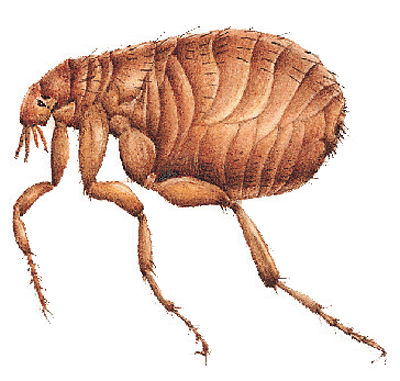
Fleas are capable of transmitting plague and murine typhus to humans, but it's pretty rare. For the most part fleas are more of a nuisance than anything else.

They are not picky about their meals; any warm-blooded animal will do. Bites usually cause minor itching, but may be more irritating to those with sensitive skin. Some people and pets suffer from flea allergy dermatitis, lasting up to 5 days and characterized by intense itching, reddening at the bite site, hair loss, and secondary infection.

Fleas also serve as intermediate hosts of the tapeworm (Dipylidium caninum). This intestinal parasite is transmitted to the pet while grooming via ingestion of an adult flea carrying a tapeworm cyst. The flea is infected by ingestion of the cyst during its larval stage. The parasite segments resemble small pieces of rice and may be discovered around the anal region of your pet.

Source: University of Florida Extension Service

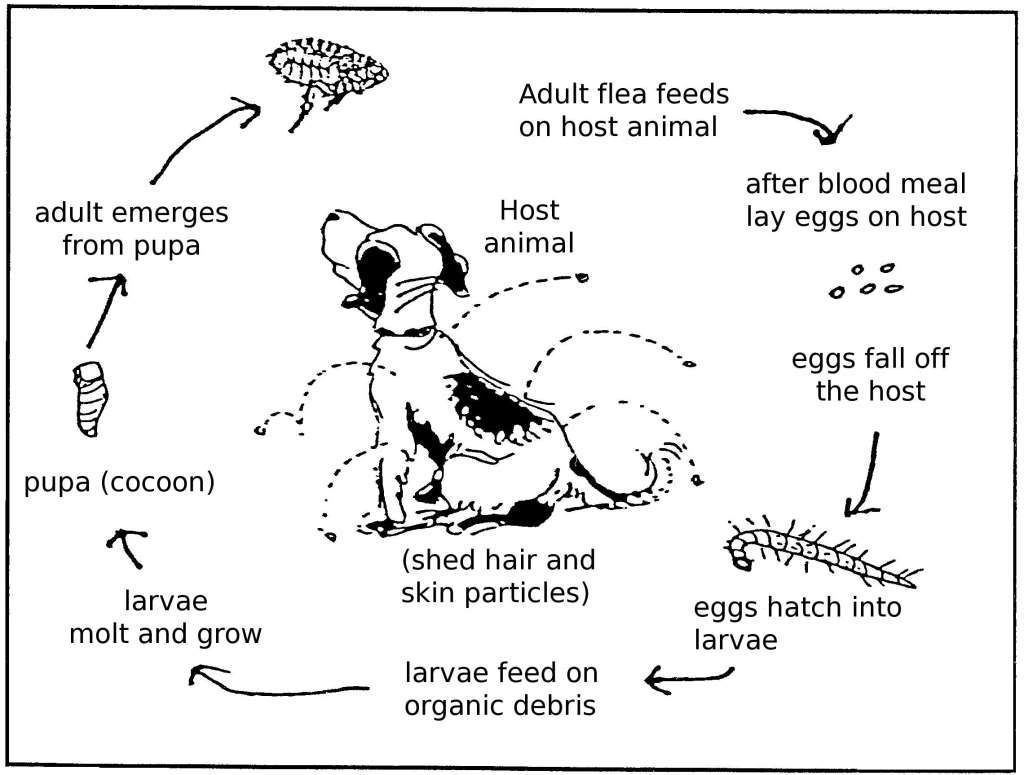
Life Cycle of a Flea


Female fleas lay eggs, usually on the host (your pet), however, the eggs are not attached to the hair and soon fall off and develop on the ground or in the pet's bed or resting place.

Flea eggs are oval, smooth, and white in color. Although they are tiny, they are visible to the naked eye if you know what to look for. They are soon lost in the surroundings. The eggs are laid by the adult flea, one egg at a time, while it is ´riding´ on your pet. Female fleas are very prolific and can lay up to 50 eggs a day.

The eggs hatch in 2 to 12 days under favorable conditions (65-80 degrees F, and at least 70% relative humidity). The flea grub or larva hatches by hacking a hole in the eggshell with a specially developed area of the mouth, usually refered to as a ´milk tooth´.

The young larvae are tiny, whitish, and legless, with bristly hairs. They are also visible to the naked eye. They are eyeless, legless and sparsely covered with hairs. Because the larva is sticky and covered in hairs, it quickly becomes coated in any form of dust or debris in its surroundings which camoflage it nicely.

Larvae tend to avoid light by burrowing down into carpeting, or hiding under pet bedding. It then feeds on food particles present in the dust and debris arround it.
Flea larvae feed on organic debris (hair, dander, and shed skin of the animal), their own cast skins, and on the feces of adult fleas. The larval stage may last from 4 to 24 days in the summertime, 21 to 200 days under less favorable conditions.

When fully grown, the larva spins a silken cocoon and enters the pupal or resting stage. Having covered itself in sticky silk it is again disguised by the dust and debris in its surroundings. Safely inside it will metamorphose into the adult flea.

Under optimal conditions, new adults are ready to emerge within 2 weeks. They develop faster at higher temperatures, but can remain in their cocoons and stay alive for up to 2 years before hatching.

The main trigger for adult fleas to emerge seems to be vibration. A room can be empty for several months, but walking across the floorboards can cause enough disturbance that a host of fleas will be rampant within minutes.

The adult cat and dog fleas emerge from the pupae, and often crawl up on blades of grass outdoors, or onto furniture, draperies or the like indoors, and wait for a host to pass. If anything in the vicinity is at the same temperature as blood, the fleas are rapidly attracted to it - you, the dog, the cat, or anything else which may be a source of food.

They jump quickly onto the new host and begin feeding. Adults of the cat flea and dog flea are long-lived; they may live for a year of more, with periodic feeding. It is only during the adult stage that the flea lives on your pet and feeds on fresh blood.

Having fed, they are then able to lay an egg. They can repeat this process up to once every half hour when at their peak, and can lay more than 300 eggs in a lifetime. These move into the surroundings and off we go again! The whole cycle in good Summer weather or efficient central heating can be comfortably less than four weeks.

Dispite popular belief, most fleas do not pass animal to animal, but stay with the host that they first attack. Most infections are picked up directly from the environment. Of course other infected animals will be contributing to the pool of new infestation by shedding eggs. Hence most animals in fact set up their own private supply of pet fleas.

Source: University of Florida Extension Service