Thursday, 2 July 2009

Fun Flea Facts

Everyone knows fleas aren´t fun.
However, here are some flea facts that will amaze you!


  • Flea fossils date back to the Lower Cretaceous period, meaning fleas have been around for about 100 million years. At that time, fleas may have infested a Tyrannosaurus Rex or Triceratops!


  • Fleas can jump up to 150 times their own length. To put that into perspective, if a human competed in the Olympic long jump with that ability, that athlete would certainly win the gold medal with a gravity-defying 1,000 foot long jump.


  • On average, a flea´s lifespan is two to three months. However, pre-emerged fleas (not living on a pet) can survive undisturbed and without a blood meal for more than 100 days.


  • The female flea can lay 2,000 eggs in her lifetime.


  • The female flea consumes 15 times her own body weight in blood daily.


  • The largest recorded flea is the North American Hystrichopsylla schefferi. Found in beavers, it can measure 12mm in length - almost 1/2-inch!


  • A flea can bite 400 times a day!. That´s a rate of 4,000 bites a day if your pet has just 10 fleas.

Problems Associated With Fleas


Fleas are capable of transmitting plague and murine typhus to humans, but it's pretty rare. For the most part fleas are more of a nuisance than anything else.

They are not picky about their meals; any warm-blooded animal will do. Bites usually cause minor itching, but may be more irritating to those with sensitive skin. Some people and pets suffer from flea allergy dermatitis, lasting up to 5 days and characterized by intense itching, reddening at the bite site, hair loss, and secondary infection.

Fleas also serve as intermediate hosts of the tapeworm (Dipylidium caninum). This intestinal parasite is transmitted to the pet while grooming via ingestion of an adult flea carrying a tapeworm cyst. The flea is infected by ingestion of the cyst during its larval stage. The parasite segments resemble small pieces of rice and may be discovered around the anal region of your pet.

Source: University of Florida Extension Service

Life Cycle of a Flea


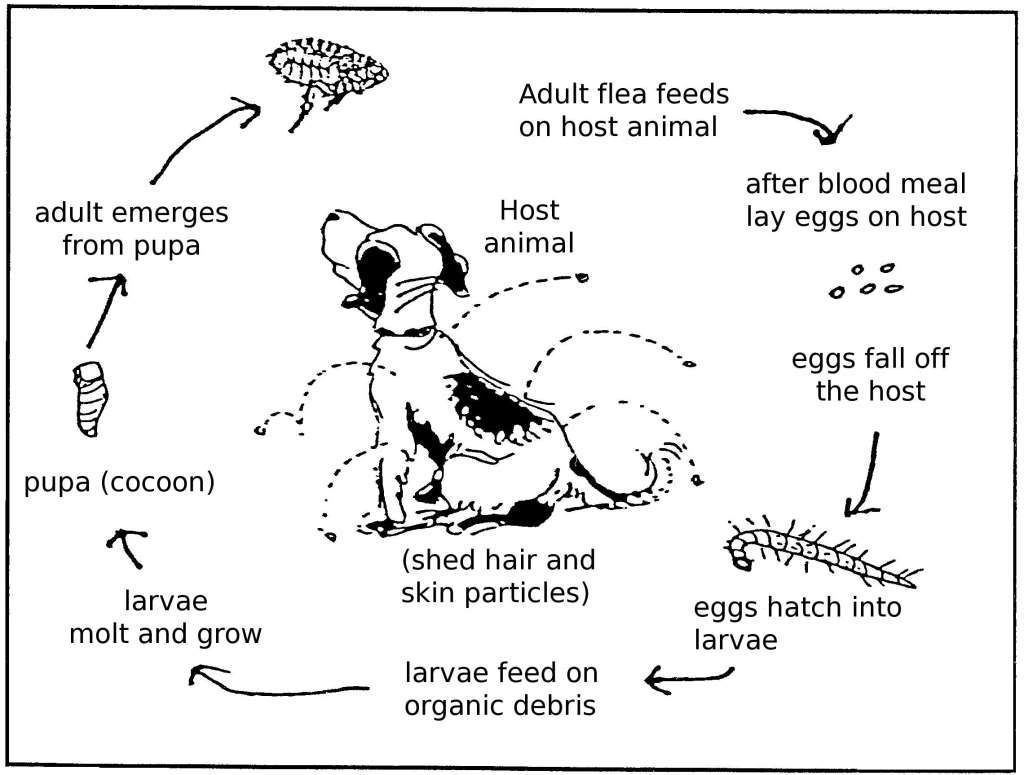
Female fleas lay eggs, usually on the host (your pet), however, the eggs are not attached to the hair and soon fall off and develop on the ground or in the pet's bed or resting place.

Flea eggs are oval, smooth, and white in color. Although they are tiny, they are visible to the naked eye if you know what to look for. They are soon lost in the surroundings. The eggs are laid by the adult flea, one egg at a time, while it is ´riding´ on your pet. Female fleas are very prolific and can lay up to 50 eggs a day.

The eggs hatch in 2 to 12 days under favorable conditions (65-80 degrees F, and at least 70% relative humidity). The flea grub or larva hatches by hacking a hole in the eggshell with a specially developed area of the mouth, usually refered to as a ´milk tooth´.

The young larvae are tiny, whitish, and legless, with bristly hairs. They are also visible to the naked eye. They are eyeless, legless and sparsely covered with hairs. Because the larva is sticky and covered in hairs, it quickly becomes coated in any form of dust or debris in its surroundings which camoflage it nicely.

Larvae tend to avoid light by burrowing down into carpeting, or hiding under pet bedding. It then feeds on food particles present in the dust and debris arround it.
Flea larvae feed on organic debris (hair, dander, and shed skin of the animal), their own cast skins, and on the feces of adult fleas. The larval stage may last from 4 to 24 days in the summertime, 21 to 200 days under less favorable conditions.

When fully grown, the larva spins a silken cocoon and enters the pupal or resting stage. Having covered itself in sticky silk it is again disguised by the dust and debris in its surroundings. Safely inside it will metamorphose into the adult flea.

Under optimal conditions, new adults are ready to emerge within 2 weeks. They develop faster at higher temperatures, but can remain in their cocoons and stay alive for up to 2 years before hatching.

The main trigger for adult fleas to emerge seems to be vibration. A room can be empty for several months, but walking across the floorboards can cause enough disturbance that a host of fleas will be rampant within minutes.

The adult cat and dog fleas emerge from the pupae, and often crawl up on blades of grass outdoors, or onto furniture, draperies or the like indoors, and wait for a host to pass. If anything in the vicinity is at the same temperature as blood, the fleas are rapidly attracted to it - you, the dog, the cat, or anything else which may be a source of food.

They jump quickly onto the new host and begin feeding. Adults of the cat flea and dog flea are long-lived; they may live for a year of more, with periodic feeding. It is only during the adult stage that the flea lives on your pet and feeds on fresh blood.

Having fed, they are then able to lay an egg. They can repeat this process up to once every half hour when at their peak, and can lay more than 300 eggs in a lifetime. These move into the surroundings and off we go again! The whole cycle in good Summer weather or efficient central heating can be comfortably less than four weeks.

Dispite popular belief, most fleas do not pass animal to animal, but stay with the host that they first attack. Most infections are picked up directly from the environment. Of course other infected animals will be contributing to the pool of new infestation by shedding eggs. Hence most animals in fact set up their own private supply of pet fleas.

Source: University of Florida Extension Service

How do I know if my pet has fleas?

A few relatively simple observations can help determine the extent of a flea problem. Keep an eye on your pet and watch for how much it scratches. Note if and when fleas attempt to bite people. Determine where fleas are active by walking through suspect areas wearing white socks (tuck in pant legs), which allows you to see the fleas as they try to bite.

Or, if you suspect fleas are present, place a shallow pan of water, containing a little dishwashing detergent or vegetable oil, on the floor, and place a gooseneck lamp with the light about 6 inches above the liquid surface. Adult fleas try to leap toward the light at night, and fall into the liquid and drown.

Use a flea comb to comb your pets regularly. The flea comb removes fleas from a pet, but doesn't kill them. Inspect the comb after each pass over the pet, and dip the comb into a bowl of warm soapy water (or a glass of water with a squirt of dish detergent), or pull captured fleas from the comb and drop them into the container of soapy water to drown them.

Remember, it just takes two fleas to create a huge flea problem, so if you see a flea, do something about it right away.

What is a flea?

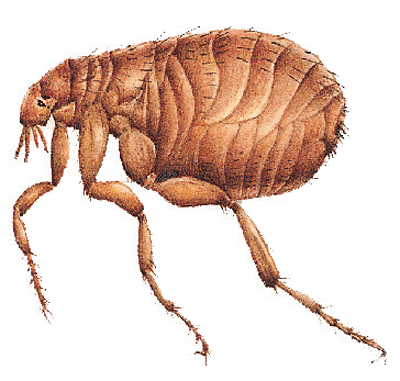
Fleas are small insects, about ¼ inch in length, laterally flattened, and brown to black or gray in color. They are wingless, and have long hind legs for jumping. Fleas have sucking mouthparts, and as adults, feed on the blood of mammals or birds. Many species are very annoying because of their bites, and a few act as vectors for disease. Some people and pets are known to develop allergic reactions to flea bites.

Fleas become pests when they get into our houses. Fleas in houses are usually linked with a pet or a visiting cat or dog. Cat fleas (Ctenocephalides felis), and dog fleas (Ctenocephalides canis) are the species most often found in houses. Wild animals have fleas also, and if such animals are living in the homes, fleas may become a problem. Flea problems often occur when the host animal had been absent for a period of time, such as when the family goes on vacation, taking or boarding the pet. Fleas may also be driven into the house during prolonged periods of wet weather.

Each species of flea has one or two kinds of animals it prefers, although when hungry, it will attack a wide variety of warm-blooded animals, sometimes including humans. Adult fleas live on the blood of the animals, and must have a blood meal to reproduce.

Cat and dog fleas periodically jump on and off the host. When the host is removed for a period of time, they are left without food. Hungry adult fleas often attack on the first warm-blooded animal that comes in the door, often biting people around the ankles. In addition, vibrations are known to promote emergence of new adults from pupae; walking across the floor may trigger emergence.

Source: University of Florida Extension Service

It's A Flea Circus!

acme miniature circus poster
The Acme Miniature Circus is an authentic Victorian style flea circus.
ARTWORK CREDIT: JAIME MURPHY

flea circus
Professor A.G. Gertsacov examines one of the stars of his Victorian style flea circus.
PHOTO CREDIT: DENNIS HLYNSKY

flea circus
The Acme Miniature Circus features trained fleas as seen before (and on top of) The Crowned Heads of Europe.
PHOTO CREDIT: DENNIS HLYNSKY

flea circus
Professor Gertsacov inspects his audience to see if they have fleas. Gertsacov guarantees that no one leaves his show with more fleas than they came in with.
PHOTO CREDIT: DONNA ATWOOD

flea circus
Professor A.G. Gertsacov gives an illustrated history of the flea before the fleas perform their stunts.
PHOTO CREDIT: DONNA ATWOOD

flea circus
Professor A.G. Gertsacov peers through the highpowered magnifying glass he uses to view his fleas.
PHOTO CREDIT: KRISTOF

flea circus
Professor A.G. Gertsacov prepares the Flaming Hoop of Death.
PHOTO CREDIT: KRISTOF

flea circus
The lavishly decorated miniature trailer that the stars of the Acme Miniature Circus call home.
PHOTO CREDIT: M.B.Gertz

flea circus

Isn't this fun?
Oh, but wait!
There's more!
We even have a video!


Oh Hey!
And here's another one!


Flea Power??

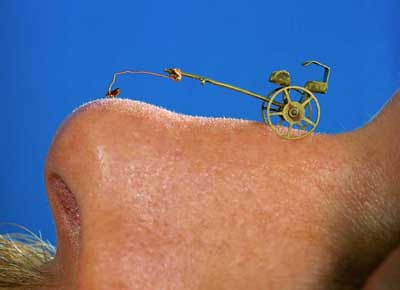
Here's a picture of a flea pulling a cart, and no, it's not photoshopped. This is a real flea, hooked up to a tiny cart, balanced on someone's nose. It'd be a bad time to sneeze, wouldn't it?